There is an important distinction between an air conditioner blowing completely hot air and one that is running non-stop but simply failing to produce crisp, cold air. When your registers output tepid, 74-degree air while the thermostat is set to 70°F, your HVAC system has suffered a significant drop in cooling capacity.
In Naples and Collier County, cooling systems face extreme outdoor temperatures combined with relentless humidity from the Gulf of Mexico. When an air conditioner operates at diminished capacity, your home feels muggy, sticky, and uncomfortable, while your monthly power bills soar. Understanding how cooling efficiency is measured and where the bottlenecks occur is key to restoring peak comfort.
Understanding 'Delta T': The Science of Cold Air
Before declaring that your AC is failing to blow cold air, HVAC technicians look at a crucial metric called Delta T (temperature split). Delta T is the difference in air temperature between your return grill (where room air enters the ductwork) and the supply register (where conditioned air exits).
- Normal Performance: In a properly charged, balanced HVAC system operating in Southwest Florida, Delta T should measure between 16°F and 20°F. If your return air is 76°F, the air exiting your supply vents should measure between 56°F and 60°F.
- Insufficient Cooling: If your temperature split is only 8°F to 12°F, the air will feel lukewarm or mildly cool, and the system will run for hours without reaching your thermostat setpoint.
- Excessive Split (Over 22°F): This often indicates critically low airflow, frequently caused by a severely choked air filter or blocked return duct. While the air exiting the vent feels icy, insufficient cubic feet per minute (CFM) means the house never cools down.
Quick Homeowner Delta T Test
Place a standard digital kitchen probe thermometer directly into your return grill for 3 minutes, record the reading, and then place it directly inside the supply vent closest to your air handler. If the difference is less than 15°F, your system requires professional cooling diagnosis.
Top Reasons Your AC Isn't Producing Cold Air
1. Leaking or Deteriorated Attic Ductwork
In Naples homes, air handlers and distribution ductwork are predominantly located in unconditioned attic spaces. During mid-day summer hours, attic temperatures routinely hit 130°F to 140°F. If flexible ductwork has torn seams, deteriorated tape, or disconnected collars, two disastrous things happen:
- Your system blows expensive, chilled air directly into the blazing attic.
- Negative pressure inside return ducts pulls superheated, dusty, humid 135°F attic air directly into the air handler, overwhelming the evaporator coil and drastically heating up the supply air before it reaches your living room.
2. Restricted Metering Device (TXV or Piston)
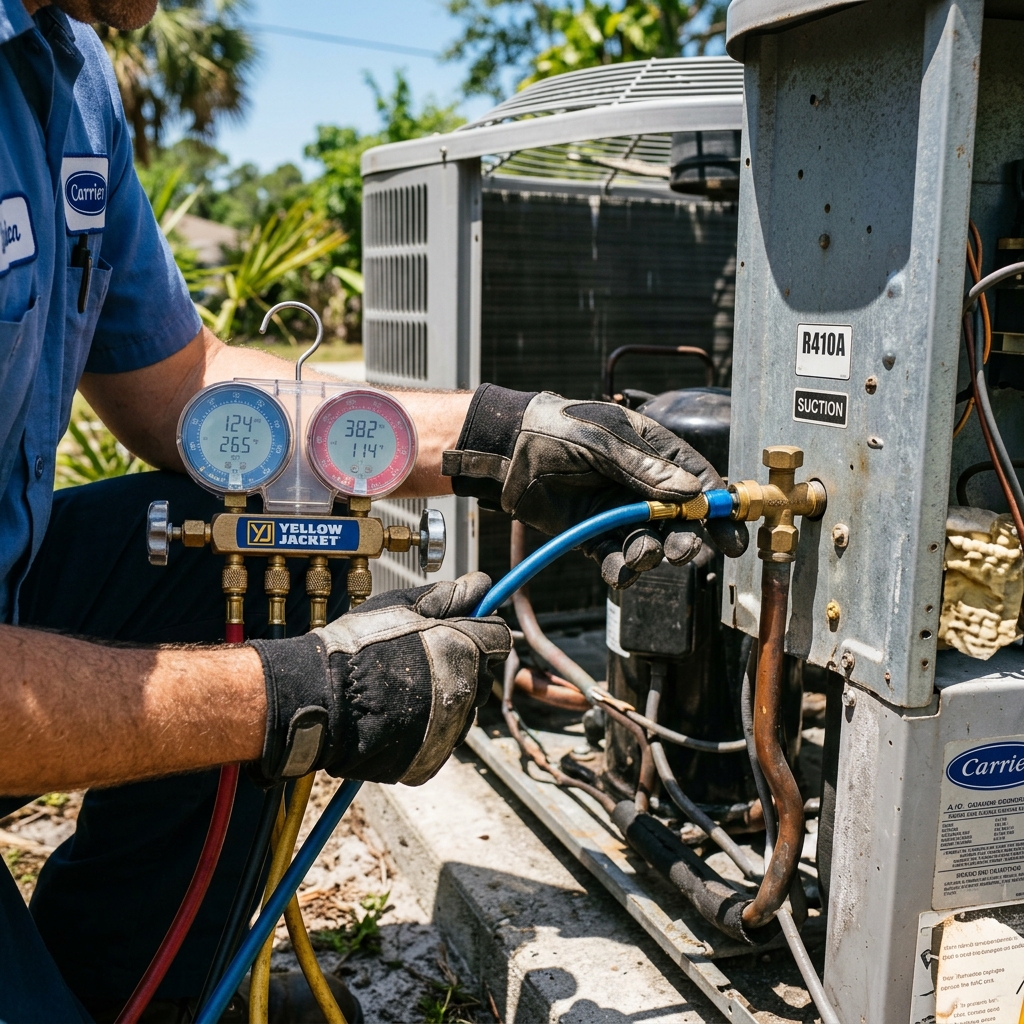
The thermostatic expansion valve (TXV) is the precision component that meters high-pressure liquid refrigerant into the indoor evaporator coil, causing the rapid pressure drop that generates freezing temperatures. If moisture, copper particulate, or degraded compressor oil clogs the valve's tiny internal orifice, the coil is starved of refrigerant. The evaporator coil cannot achieve its design saturation temperature, and the air blown into your rooms remains warm and humid. Addressing this requires professional compressor valve and metering diagnosis.
3. Aging Compressor Valve Failure
The compressor contains internal suction and discharge reed valves that compress low-pressure vapor into high-pressure gas. In systems over 8 to 10 years old, high compression ratios and thermal wear can cause valves to crack, leak, or fail to seal completely. When internal valves bypass, the compressor cannot generate sufficient head pressure. It draws lower electrical current, hums normally, but produces virtually no cooling work.
4. Dirty, Algae-Coated Evaporator Fins
Because indoor coils are constantly wet from condensing humidity, airborne dust and household aerosols cling to the aluminum fins, forming an insulating felt-like mat. This grime barrier prevents heat exchange between indoor air and the refrigerant flowing through the copper tubes. Professional chemical coil sanitation restores clear heat transfer and eliminates musty "dirty sock" odors.
5. Severely Sun-Baked Outdoor Condenser Location
Condensers installed against unshaded southern or western exterior walls receive intense solar radiation. If surrounding landscape plantings, pool equipment enclosures, or hurricane shutters restrict exterior airflow to less than 24 inches of clearance, the unit recirculates its own hot exhaust air. As outdoor coil temperatures climb above 125°F, cooling efficiency plummets.
Single-Stage vs. Variable-Speed Inverter Systems: Why Air Feels Different
Many homeowners who recently upgraded to high-efficiency variable-capacity systems (such as Daikin, Trane, or Carrier inverter units) notice that supply air does not always feel "ice cold."
Traditional single-stage systems operate at 100% capacity whenever they turn on, blasting 55°F air for short 10-minute bursts before shutting off. In contrast, modern inverter systems ramp down to 30% or 50% capacity, blowing gently conditioned 62°F air for long, continuous cycles. This extended runtime is intentional: it continuously wrings humidity out of your home, maintaining 50% relative humidity and superior comfort with lower electrical usage. If your humidity is low and your thermostat is satisfied, gentle supply air is normal behavior. However, if indoor humidity exceeds 60% and temperatures rise, your system requires inspection.
Solutions and Corrective Steps
| Symptom Observed | Likely Root Cause | Recommended Solution |
|---|---|---|
| Delta T under 12°F, outdoor line warm | Low refrigerant or stuck TXV | Nitrogen leak test & recharge |
| Vents blow weak, humid air | Dirty coil or choked filter | Replace filter & sanitize coil |
| Some rooms cold, others hot | Duct leaks or static imbalance | Duct sealing & damper balance |
| Outdoor unit runs loud, no cooling | Compressor valve bypass | Compressor replacement / repair |
Frequently Asked Questions About Weak Cooling
Why does my AC blow cold in the morning but warm in the afternoon?
Morning outdoor temperatures in Naples are typically 76°F to 80°F, placing minimal heat load on your condenser. By 2:00 PM, outdoor temperatures hit 92°F with intense radiant sun on your roof. If your system is slightly low on refrigerant, has dirty coils, or has undersized ductwork, it can manage the light morning load but falls apart when afternoon thermal demand peaks.
Can low voltage from the power company affect cooling?
Yes. During extreme heat waves, neighborhood electrical grids experience voltage sags (brownouts). When line voltage drops from 240V down to 215V, your compressor draws higher amperage to compensate, generating severe internal heat. In response, internal thermal limit switches trip the compressor offline, leaving only the indoor fan circulating room-temperature air.
When Does Poor Cooling Warrant System Replacement?
If your air conditioner is more than 10 to 12 years old, utilizes phased-out R-22 Freon, or suffers from a failing compressor combined with a rusted evaporator coil, continuous repair costs frequently surpass the value of the equipment. Modern variable-capacity inverter systems achieve SEER2 ratings of 18 to 22+, providing continuous dehumidification that keeps Naples homes at 50% relative humidity even on 95-degree afternoons while reducing electric bills by up to 35%. Explore our HVAC system replacement options to evaluate the long-term economics of upgrading.
Conclusion
Living with an AC that refuses to blow cold air is unnecessary and damaging to your equipment. Start with basic filter inspections and thermostat verification. If your temperature split remains below 16°F, schedule an inspection with our team for certified AC not cooling repairs in Naples, FL.