Few household sights feel more surreal than peering into your air handler closet on a sweltering 94-degree Naples afternoon and seeing copper pipes encrusted in thick white frost or a solid block of ice encasing your evaporator coil. While freezing might sound like the ultimate sign of cooling power, an iced-up air conditioner is actually a system in severe mechanical distress.
Left unchecked, a frozen air conditioner will completely choke off airflow, flood your equipment platform as ice thaws, and cause catastrophic compressor failure. If you have spotted frost or ice on your system, understanding why it happens and following the correct emergency shutdown protocol will save you thousands of dollars in avoidable repair bills.
The Physics of Freezing: How Ice Forms in 90-Degree Weather
To understand why an AC freezes, you have to understand how air conditioners create cold air. Your air conditioner does not actually "generate cold"—it absorbs heat from inside your home and transfers it outdoors.
Refrigerant (typically R-410A) enters the indoor evaporator coil as a cold, low-pressure liquid at approximately 40°F to 44°F. As warm indoor air is pushed across the coil by the blower motor, the refrigerant absorbs thermal energy from the air, warming up as it turns into vapor and carrying that heat outside.
Ice forms when this continuous heat exchange is interrupted. If heat cannot transfer from the indoor air into the refrigerant, the pressure inside the evaporator coil plummets. In refrigeration physics, lower pressure directly creates lower saturation temperatures. When coil temperatures dip below the 32°F freezing mark, moisture condensing out of the humid Florida air instantly freezes into frost. As frost builds, it blocks airflow further, insulating the coil from any remaining warm air and causing a runaway freezing cycle until the entire unit turns into a block of solid ice.
Immediate Action Protocol
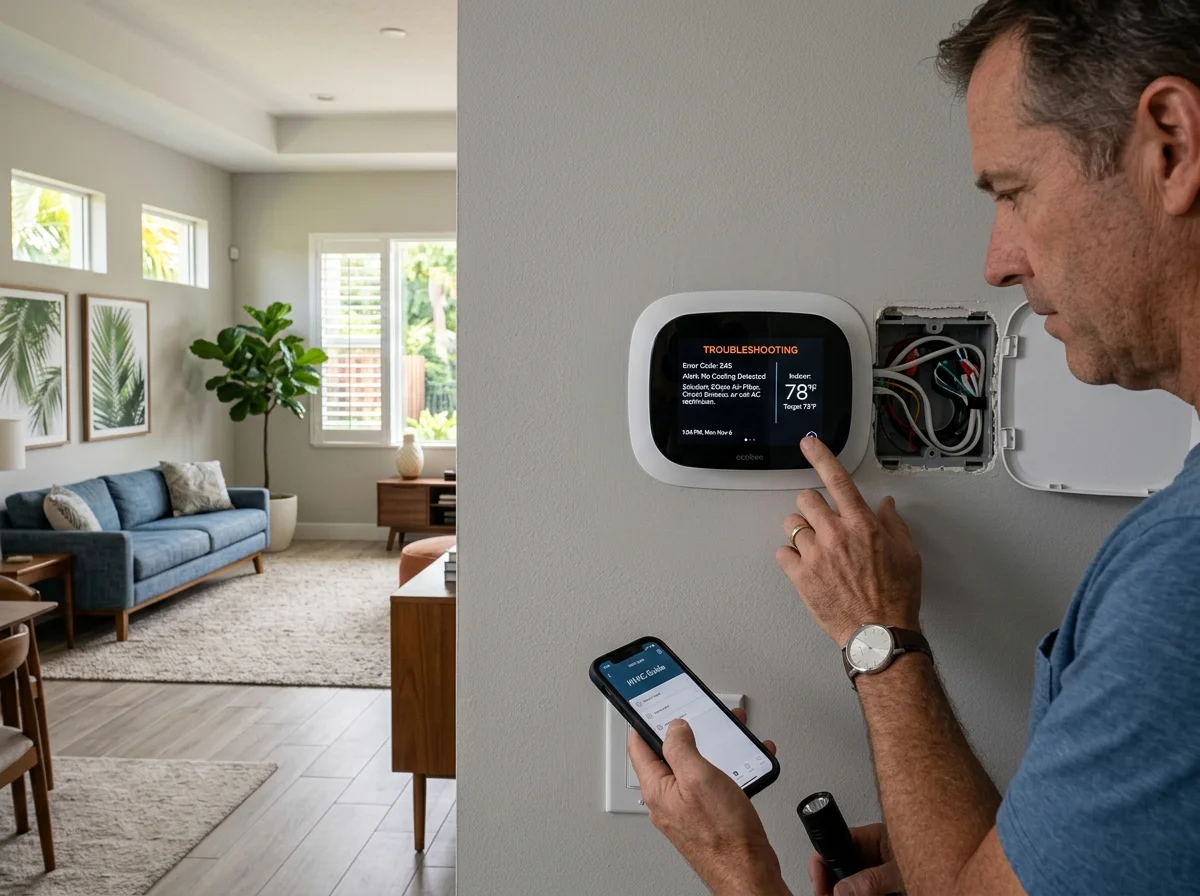
If you see ice anywhere on your air conditioning unit, turn the system OFF at the thermostat right now, but switch the fan setting to ON. Do NOT chip at the ice with tools or knives, which can puncture fragile aluminum coil tubes and cause toxic refrigerant blowouts.
The 4 Primary Causes of Frozen AC Units in Naples
1. Restricted Airflow Across the Evaporator Coil
Airflow restriction is responsible for roughly 75% of all frozen evaporator calls in Collier County. When indoor air cannot pass freely across the coil fins, there is simply not enough thermal energy to keep the refrigerant above freezing:
- Clogged 1-Inch Air Filters: A neglected filter covered in dust and pet hair acts as a solid blanket, starving the blower of return air.
- Closed or Obstructed Supply Registers: Closing bedroom supply vents or blocking return air grills with heavy drapery or furniture severely reduces total cubic feet per minute (CFM).
- Dirty Blower Wheel: Over years of continuous operation, fine dust clings to the concave blades of the squirrel-cage blower wheel, reducing fan velocity by up to 50%.
2. Low Refrigerant Charge from a Pressure Leak
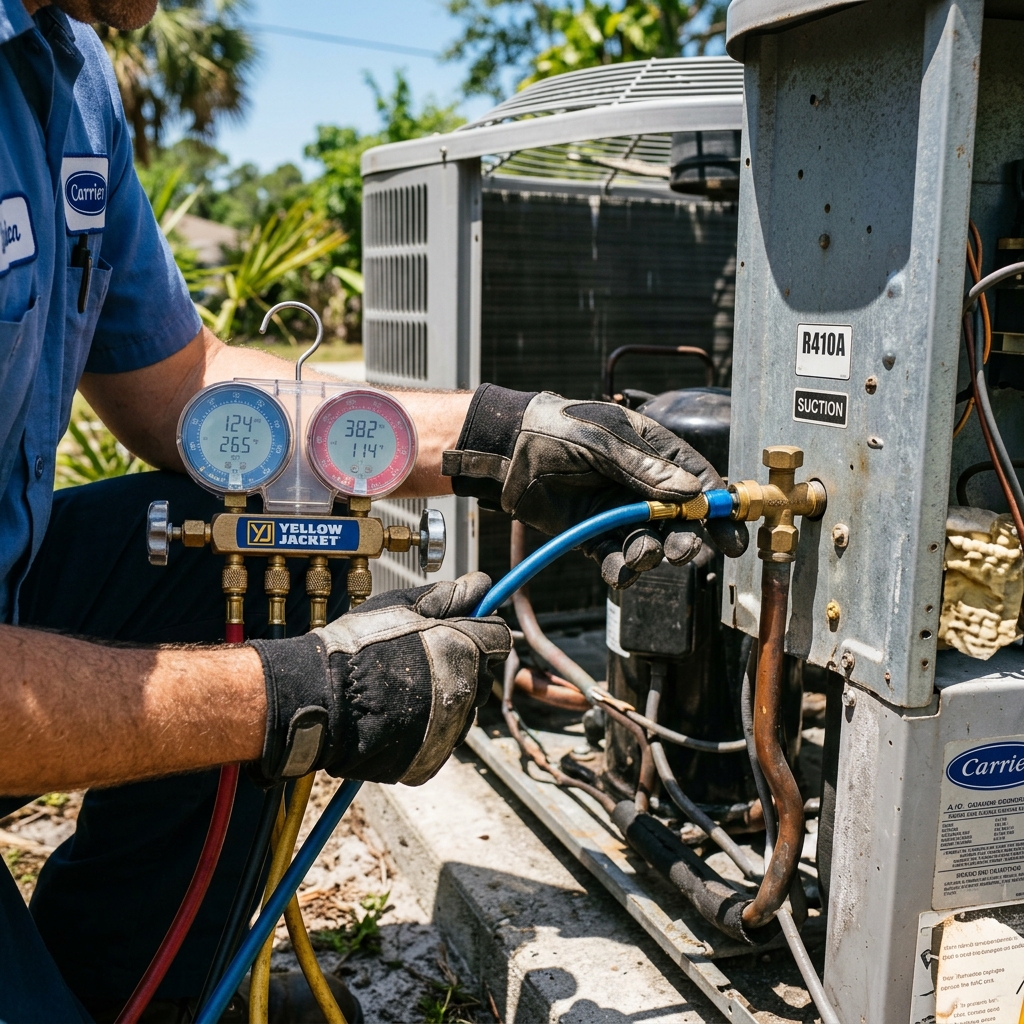
When an HVAC system develops a pinhole leak in its copper tubing or coil joints, the total volume of refrigerant in the system declines. Less refrigerant means lower operating pressure throughout the evaporator. As pressure falls below design specifications (typically around 118 PSI for R-410A), coil temperatures drop from a safe 42°F down to 28°F or lower. Condensing water freezes immediately upon contact with the metal fins. If your unit freezes even with a brand new, clean filter, you almost certainly have a refrigerant leak requiring electronic leak detection.
3. Blower Motor or Run Capacitor Failure
If the motor driving your indoor fan fails—or if its run capacitor loses electrical capacitance—the fan will spin too slowly or stop spinning entirely. Without forced air moving across the coil, the liquid refrigerant sits idle and freezes within minutes of the compressor starting.
4. Thermostatic Expansion Valve (TXV) Metering Failure
The TXV regulates the exact rate at which refrigerant expands into the evaporator. If the valve's sensing bulb loses charge or its internal needle sticks shut, the evaporator is severely starved of refrigerant volume, causing localized flash-freezing at the expansion distributor tubes that spreads rapidly across the coil face.
Comparing Airflow Freeze vs. Refrigerant Freeze
| Diagnostic Check | Airflow Restriction Freeze | Refrigerant Leak Freeze |
|---|---|---|
| Air Filter Condition | Heavily coated in gray dust or pet dander | Clean or recently replaced |
| Ice Pattern | Entire coil covered in uniform solid ice sheet | Ice starts on lower circuit / suction brass pipe |
| Air Velocity at Registers | Barely any air blowing even on HIGH | Moderate airflow, but air feels lukewarm |
| Outdoor Copper Pipe | Large suction line heavily frozen | Suction line frozen or barely cool |
Step-by-Step: What Homeowners Should Do When the AC Freezes
- Switch Thermostat to OFF: This disengages the outdoor compressor, stopping the continuous generation of sub-freezing temperatures.
- Switch Fan Setting to ON: Running the indoor fan circulates room-temperature (75°F–80°F) air across the frozen coil, speeding up the thawing process safely without artificial heat.
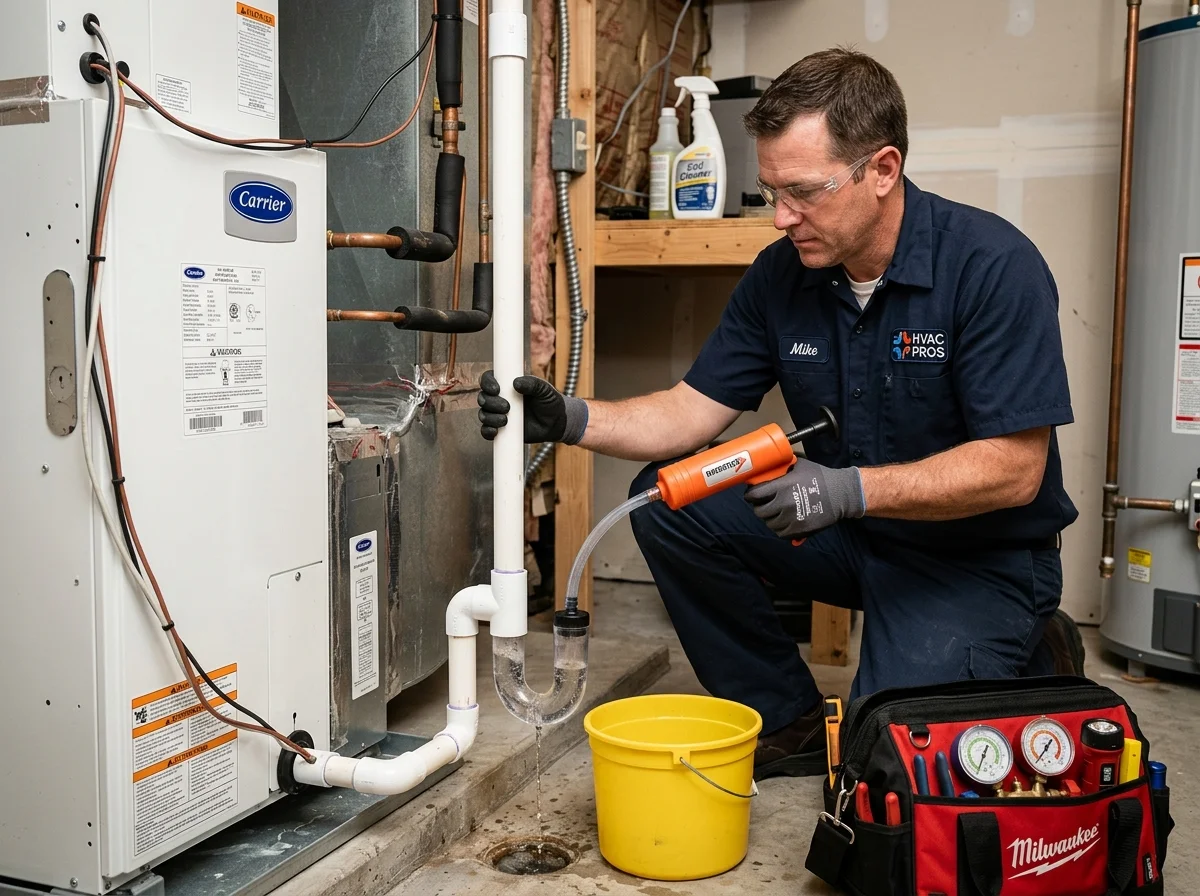
- Prepare for Significant Water Runoff: A heavily frozen coil can contain several gallons of frozen water. As it melts, water will rush into the condensate pan. Check the drain line to ensure it is flowing freely, and place towels around the air handler base to catch any overflow.
- Allow 2 to 4 Hours to Fully Thaw: Do not attempt to run the AC or schedule a technician until the ice has completely melted. HVAC gauges and diagnostic tools cannot accurately measure refrigerant pressures or airflow through an ice-covered coil!
- Replace the Air Filter: If the filter is dirty, install a fresh replacement before restarting the unit.
Frozen AC Won't Thaw or Freezes Right Back Up?
Our licensed technicians carry ultrasonic leak detectors, nitrogen pressure rigs, and genuine OEM parts to pinpoint the root cause of coil freeze-ups and restore reliable cooling across Naples.
Why You Must Never Chip Ice Off an AC Coil
It can be tempting to grab a screwdriver, putty knife, or ice scraper and try to physically chip ice away from the frozen air handler. Never do this! Evaporator coils are constructed from paper-thin aluminum fins surrounding delicate copper or aluminum tubes holding high-pressure refrigerant. Puncturing a single tube will immediately release your entire refrigerant charge, ruin the coil, and turn an inexpensive repair into a costly multi-thousand-dollar coil replacement.
Frequently Asked Questions About Frozen AC Units
Can I use a hair dryer to speed up thawing?
We strongly discourage using hair dryers or heat guns. High localized heat can warp plastic condensate drain pans, melt internal sensor wiring, and stress soldered copper joints. The safest, fastest method is setting your thermostat fan to ON, which moves hundreds of cubic feet of warm indoor air across the coil every minute.
Will a frozen AC ruin my compressor?
Yes, if left running. When the evaporator is frozen, liquid refrigerant cannot evaporate into a gas. Instead, raw liquid refrigerant travels down the suction line directly into the compressor. Compressors are engineered strictly to pump vapor—liquid refrigerant washes away internal lubricating oil and causes catastrophic mechanical hydrostatic lockup (liquid slugging).
Conclusion
A frozen air conditioner in Naples is always symptomatic of either restricted airflow or a refrigerant pressure leak. Shut your unit off, let it thaw with the fan running, and contact AC Repair Naples Fl for reliable, same-day frozen AC repair in Naples, FL.